





Eye For Film >> Movies >> Flesh And Fuel (2026) Film Review


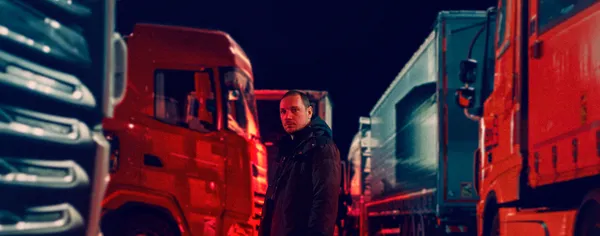

Flesh And Fuel transplants the clichés of tenderqueer cinema to unexpected, truck-driving recipients, Frenchman Étienne (Alexis Manenti) and Poland-born Bartosz (Julian Świeżewski). Their first encounter is far from a typical meet cute, as they run from the police after a failed cruising attempt. One romantic encounter later, however, they start to spend their days seeking each other out on European highways, looking forward to each short encounter; craving closeness amid neverending work.
There is a certain mismatch here. Romance blooms despite spatio-temporal obstacles and a communication barrier. Our heroes talk in a mix of French and English, supplementing any gaps in their love-pidgin with longing gazes and gentle touches. As is often the case, language betrays a certain power imbalance. Bartosz juggles languages, nimbly adapting to his francophone lover, who never bothers to learn any words in return.

But societal reality constantly undercuts this fairy tale. Writer-director Pierre le Gall represents the trucker life truthfully: precarious working conditions, demanding supervisors, loneliness that’s almost systemic. Even the narrative, wondrously free of homophobia, seems to reflect the director's sociological sensitivity. There’s no need to further torture the characters as they are suffering from the ruthless gig economy as it is. That same gig economy shifts the balance yet again, this time in Bartosz’s favour. The only good employee is a cheap one, so Eastern-European drivers are slowly replacing those from the West.
The unassuming love story thus serves a second purpose, employing a personal lens to explore the European Union’s troubling status quo. The West still sees itself as superior, exploiting the East for thankless labour but as soon as easterners get any sort of an upper hand, they are treated as a problem, accused of stealing jobs, safety, and tax money.
The tension between an intimate love story and global inequalities invades the formal aspect as well. Feelings are sensual, conveyed through composer Paul Sabin’s electro-beats, which manage to temporarily drown out the omnipresent noise of modernity. In contrast, the camerawork remains naturalistic, tirelessly capturing the gray landscapes of industrial Europe and its human cogs, never sugarcoating late-stage capitalism’s ugly substance.
That clever, minimalistic form is employed carefully, supplementing rather than overshining the film’s central interest – the romance, which can still play out with its full, heartwarming potential. This is encapsulated by a scene where Étienne and Bartosz drive past each other on a highway, screaming cheerfully. The bridge shot from a bird’s eye view makes it feel as if the entire world belongs to them; the sound, crisp and energetic, makes you want to smile and shout in tandem with the characters.
It is also thanks to the form that the two perspectives – the intimate and the global – finally coalesce in the finale. As the lovers face each other on an old town’s street, the city slowly fades into silence. Soon electronic music blasts over the understated shot of nighttime Warsaw, revealing the true nature of le Gall’s vision. In late capitalism love is not a no-longer-reachable ideal, but a way to find solace despite it.
Reviewed on: 20 Oct 2026